

At the start of October, a group of us – Swetha, Steph, Mia, Jacob and Kaz – took a trip up to Edinburgh for the Early Detection of Cancer Conference 2026. We were also joined by Cameron, who is another of Steph’s PhD students based in the Primary Care Unit working on CanRisk. In the spirit of sharing our experiences, we hope to give an insight into our time in Edinburgh in this short blog piece covering our main takeaways, and those of the six Patient and Public Partners who joined us for the conference! I (Kaz) did try to record a vlog, but unfortunately encountered two main issues: my own forgetfulness of recording enough content (one video wasn't quite enough ...) and the team's general lack of enthusiasm to being papped after a full conference day – fair enough.
We did still manage to get a few pictures in, so we hope you enjoy these interspersed throughout. Good food is a central theme in our team, so we’ll begin and end with some food pictures!
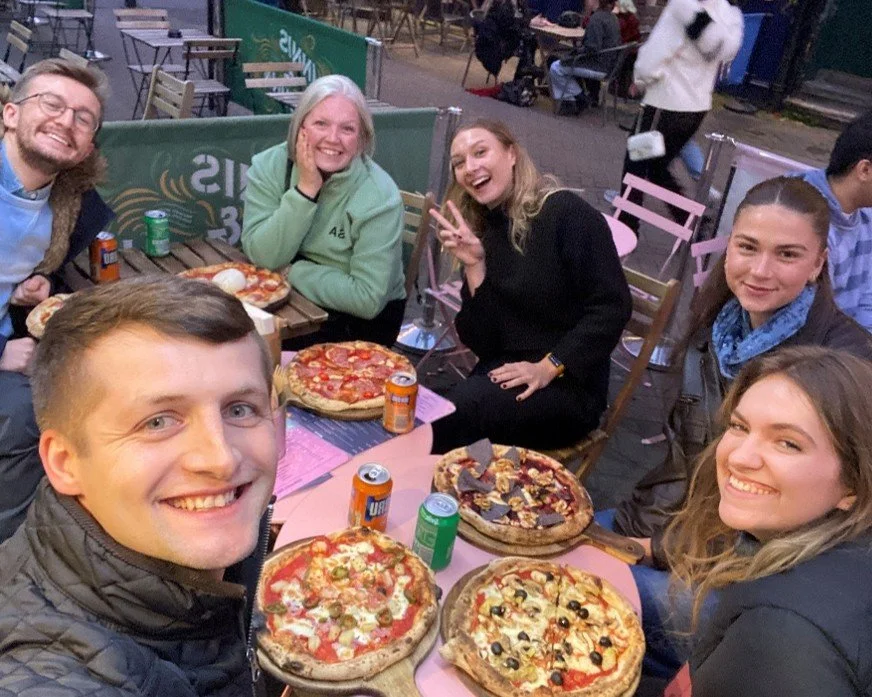
Team dinner photo following the first day of the conference taken at Jacob and Mia's personal favourite, Dough (not sponsored, although if you see this, Team at Dough, we wouldn't say no to staying in touch...) Of course, when in Rome Scotland, the Irn Bru has to make a feature (again, not sponsored but...).
Amongst a range of in-depth talks, ranging from Multi-Cancer Early Detection tests (MCEDs) and AI-imaging to puberty and breast cancer, our superstar Swetha showcased her work on improving early cancer detection for South Asian women by displaying two posters on her findings and delivering a flash talk on her overall research.
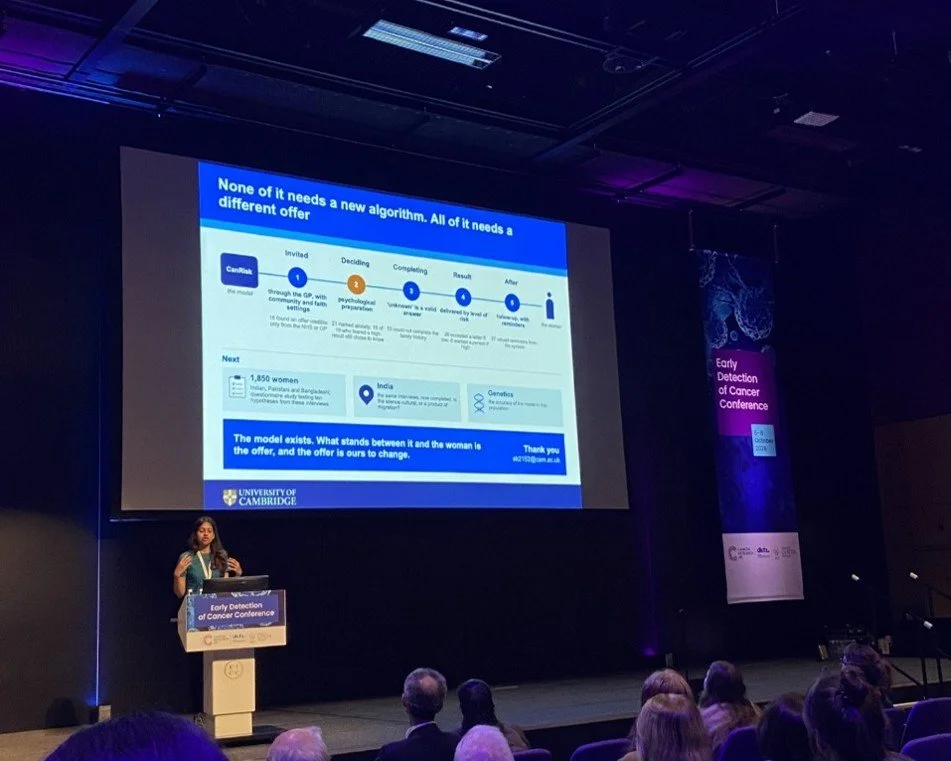
Swetha concluding her talk, presenting her research to date on breast cancer prediction for Indian women in the UK. Photo credit: her dedicated fan club sat in the audience.
Steph chaired a panel on Health Inequalities with Mia (our fabulous PhD student), Bhuvan Majmudar from Egality, Dr Ameeta Retzer from the University of Birmingham and Dave K., one of our incredible Patient and Public Partners currently working with us on the Cancer Data Driven Detection (CD3) Programme. They spoke about the importance of putting in the work to include people from a range of backgrounds in research and, as Ameeta so aptly put it: 'if not because it’s the right thing to do, do it because it's good science'.
This comment particularly stuck with us and with the other attendees who gave the following responses, prompted by the final Slido question below:
'Following the session today, what changes are you going to make to your work to better address inequalities?'
Consider intersectionality – multiple diversities
Fund PPIE work adequately
Keep accessibility in mind to a greater degree
Ensure study methodologies do not unintentionally exclude certain populations
Acknowledge selection bias and include more diverse patient advocates
Engage with affected communities from the beginning to co-develop ideas
Involve research participants in results/further work with their data
These are just a selection of responses from the session, so we were pleased, to say the least, to see the general atmosphere of enthusiasm in the room for building impactful inclusion of patient/public partners.
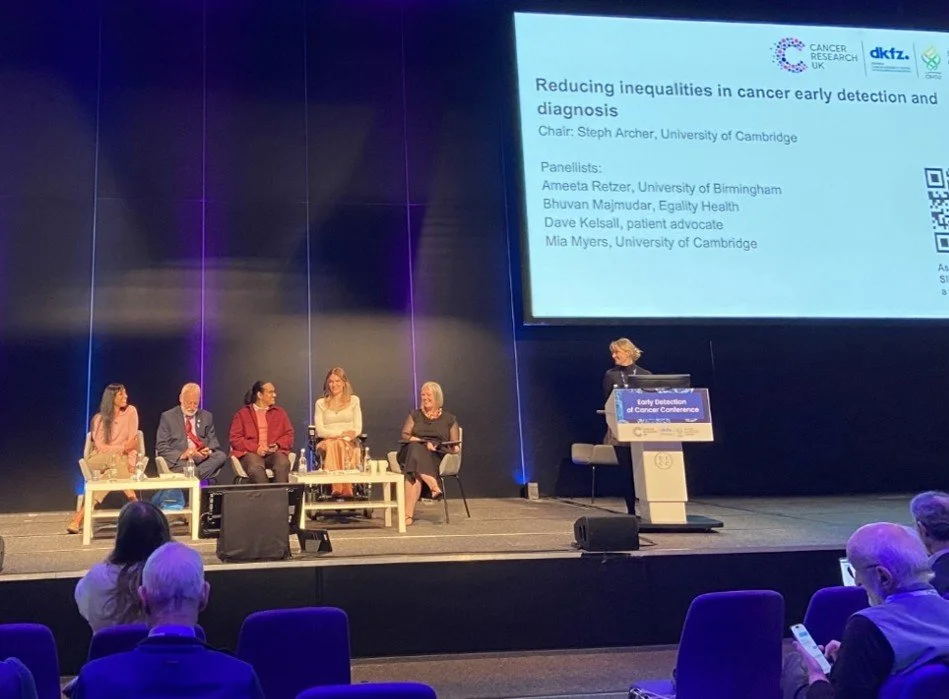
Left to right: Ameeta, Dave, Bhuvan, Mia, Steph on a panel titled ‘Reducing inequalities in cancer early detection and diagnosis’.
Side note: Going (unintentionally) undercover at the conference dinner the following day, Jacob and I had a great time speaking to our colleagues over at the Netherlands Cancer Institute who shared with us that, after listening to Mia raise some crucial accessibility issues around cervical cancer screening, they made it a point to take these back to their department to take into consideration. Once we eventually disclosed that we work with both Mia and Steph, they said how cool that must be. Of course, we enthusiastically agreed.
Most importantly, we were joined in Edinburgh by Robin, Yo, Jo, Johannes and Charles, our Patient and Public Partners from ACED (International Alliance for Cancer Early Detection), and Dave and Abdul, our Partners from CD3 (Cancer Data Driven Detection).
Dave K., who joined Steph and Mia for the panel on health inequalities, reflected that the conference was ‘almost overwhelming in the scale and complexity of the subject’ and, since his attendance at the conference two years ago, the ‘rate of both progress and change was hard to take onboard!’ As a CRUK Campaigns Ambassador, he fully supports CRUK’s national campaign, ‘Unlock Cancer Breakthroughs’ which calls on the government to remove the barriers holding back research and unlocking cancer breakthroughs, and he wished to see more about this during the conference. Dave really appreciated the networking opportunities between sessions, which he said were ‘second to none’, noting ‘where else would a British patient get the opportunity to spend ten minutes discussing why they might be a statistical outlier and unexpected Stage 4 cancer survivor with one of the world’s leading researchers in that field?’
Johannes, who joined us from Germany, also appreciated the networking opportunities in particular. His biggest takeaway was that ‘risk assessment and patient stratification is moving to an earlier stage, which is good news for patients’. He particularly enjoyed Professor Ros Eeles’ keynote speech in optimising the detection of prostate cancer.
Sharing her main takeaways from the conference, Yo shared that she is trying to piece together and establish ‘what patients can do to work with clinicians and scientists to achieve earlier detection’. Some of her main takeaways were ‘the opportunities to move forward with technological developments for analysis and testing and being able to compare and understand reasons for variation in success levels between countries’. Yo also noted that she was glad to hear about ‘calculating the economic benefit of earlier detection and diagnosis’. Overall, however, she thought that there could have been more input from patients and suggested varied points on how patients and the public could improve the attitudes towards early cancer detection. She believes that it is important for patients and the public to ‘gain a balanced view of technological potential and share experiences’ to learn how AI can be a ‘helpful tool to aid identification of illness and provide the opportunity for longer, better lives’. The international overview of the conference also ‘showed considerable variation between countries’ ability to deal with cancer’ which must be a ‘great starting point to learn how this could be achieved and how attitudes to cancer, screening and treatment vary’. Although there were a lot of interesting points raised by ‘clever, personable speakers’ there is definitely still a lot to work on together, with greater consideration for the current or potential patient.
Once the conference came to an end after three days of insightful talks, networking sessions and ‘semi bafflement from clever, personable speakers’, according to Yo, we gathered up the troops for a hybrid meeting to discuss our ACED engagement and next steps. We all fed back on our experiences of the conference, identified areas in which we can help our researchers to ensure that people with lived experiences are meaningfully contributing to their research and discussed further recruitment to diversify the experiences of the contributors on our panel.
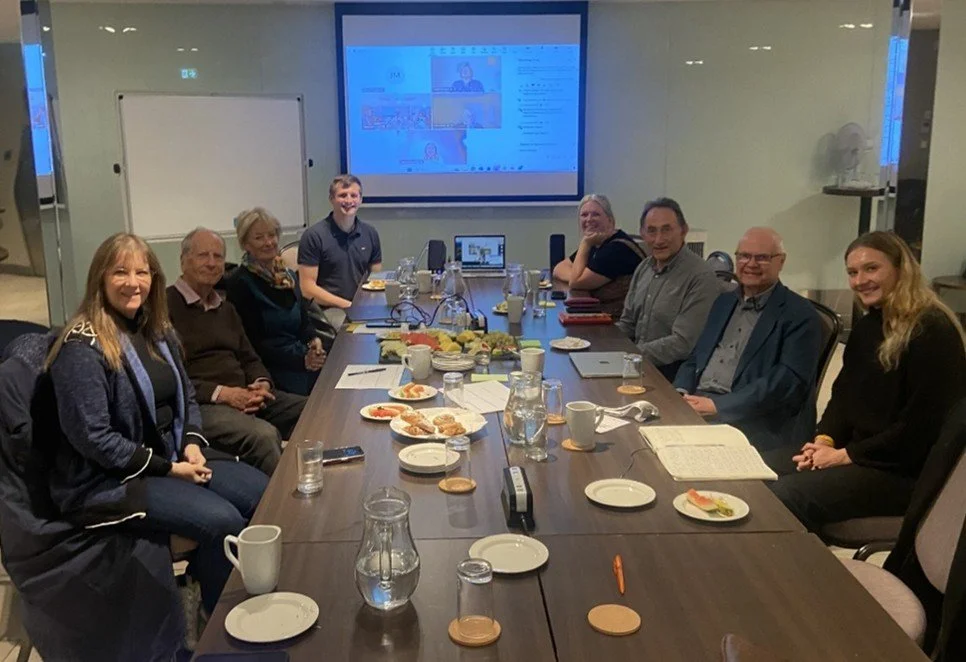
Our ACED PPIE meeting, with some partners joining us in person and some online! In true health and wellbeing style, teas and coffees were flowing throughout and fruit and pastries prepped us for our group dinner immediately afterward.
Our Edinburgh adventure ended with a wonderful group dinner at The Royal Durbar where we enjoyed a range of sharing plates, mains and drinks. All in all, a great success with amazing food and a warm atmosphere!
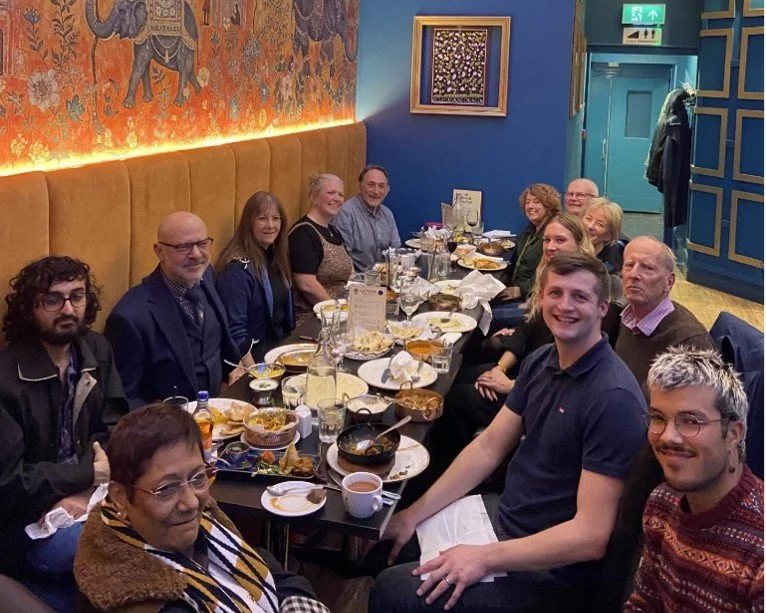
The whole team, including some additional special guests, after dinner at The Royal Durbar in Edinburgh. Thank you to Balwant, Avishek and the team for having us!
As is customary in a Health and Wellbeing Research Group blog post, below is a snapshot of smiling Steph at the end of this endeavour.
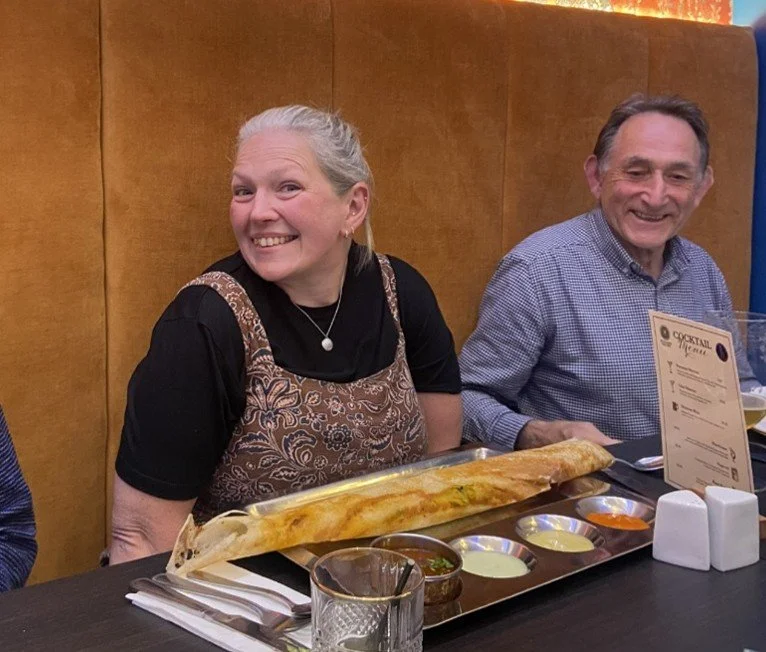
Steph’s triple threat: dungarees, dosa and dips.